.md →
ModuleTreeWidget API#
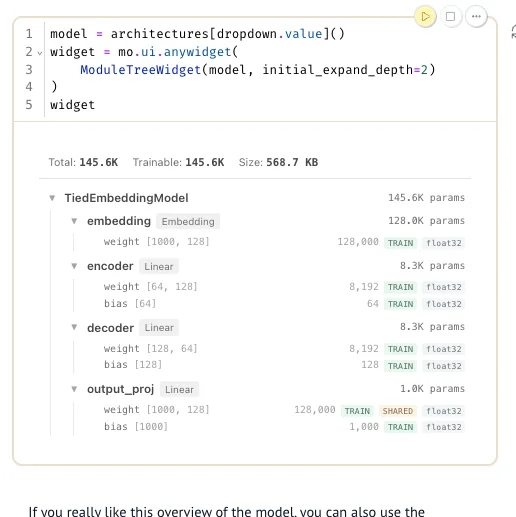
ModuleTreeWidget turns a PyTorch nn.Module into an expandable tree: every submodule with
its parameter count and per-tensor shapes, plus trainable, frozen and buffer badges and a
density indicator, so you can see where the weights in a model actually sit. If you work in
marimo you do not need it — returning an nn.Module from a cell renders the same view, since
this widget has graduated to marimo core — but it still works in plain Jupyter and other
anywidget hosts.
PyTorch is too heavy to run in the browser, so this page has no in-browser demo — run it on molab instead. See also: NestedTable for the same collapsing-tree layout over any hierarchy, Treemap for sizing a hierarchy by value, and LiveEdit for tracing what a Python function does line by line.
Bases: AnyWidget
Interactive tree viewer for PyTorch nn.Module architecture.
Displays the full module hierarchy with parameter counts, shapes, trainable/frozen/buffer badges, and a density indicator.
Note
This widget has graduated to marimo core. If you are using marimo,
you can simply return an nn.Module from a cell — marimo's
built-in PyTorch formatter will render it. ModuleTreeWidget
will continue to work in plain Jupyter and other anywidget hosts.
Examples:
import marimo as mo
import torch.nn as nn
from wigglystuff import ModuleTreeWidget

model = nn.Sequential(
    nn.Linear(784, 256),
    nn.ReLU(),
    nn.Linear(256, 10),
)
mo.ui.anywidget(ModuleTreeWidget(model, initial_expand_depth=2))
Create a ModuleTreeWidget.
Parameters:
| Name | Type | Description | Default |
|---|---|---|---|
module
|
Any
|
A PyTorch |
None
|
initial_expand_depth
|
int
|
Number of tree levels to expand initially. |
1
|
Source code in wigglystuff/module_tree.py
Synced traitlets#
| Traitlet | Type | Notes |
|---|---|---|
tree |
dict |
JSON-serializable tree extracted from a PyTorch nn.Module. |
initial_expand_depth |
int |
Number of tree levels to expand on first render (default: 1). |